

News
Focusing on precise temperature control systems for industrial equipment
News Details
07
2025
-
07
How to choose between air-cooled and water-cooled chillers?
Determine cooling capacity needs: The required cooling capacity must be calculated based on the heat generated in the actual application scenario, such as heat generated by equipment operation and ambient heat, to ensure that the cooling capacity of the selected chiller can meet the cooling needs.
Determine Cooling Capacity Needs: The required cooling capacity must be calculated based on the heat generated in the actual application scenario, such as heat generated by equipment operation and ambient heat, to ensure that the selected chiller's cooling capacity meets the cooling needs.
Consider the Usage Environment: If the installation site has limited space, lacks water, or has poor water quality, an air-cooled chiller may be more suitable; if there is sufficient space and ample water supply, a water-cooled chiller can be prioritized due to its efficient cooling performance. Ambient temperature also affects chiller performance; in high-temperature environments, a model with stronger cooling capacity should be selected.
Combine Process Requirements: Different industrial processes have different requirements for water temperature, water quality, and temperature control accuracy. For example, some high-precision production processes may require a chiller with temperature control accuracy of ±0.1℃, while some processes with high water quality requirements need suitable evaporator materials, such as 316 stainless steel or titanium tube evaporators, to prevent corrosion.
Focus on Energy Efficiency: Based on the company's own energy consumption requirements and budget, select a chiller with an energy-saving label or high energy efficiency ratio to reduce long-term operating costs.
Consider After-Sales Service: As important equipment in industrial production, chillers require reliable after-sales service support. Choosing a manufacturer with comprehensive and timely after-sales service ensures that equipment can be quickly repaired in case of failure, reducing downtime. [Company Name] promises a half-hour response to repair calls and on-site service within 4 hours for customers within the city area.
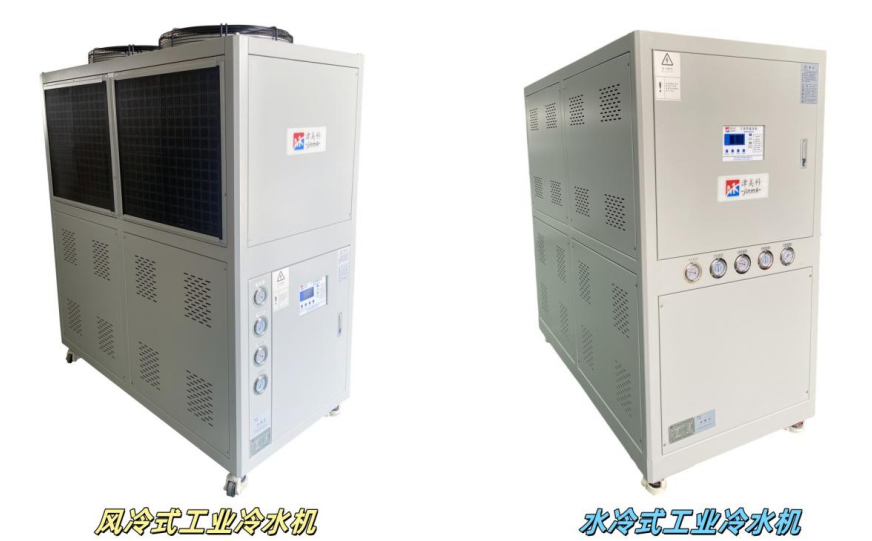
Air-cooled and water-cooled industrial chillers differ in structure and working principles. Selection requires consideration of multiple factors:
Air-cooled Industrial Chiller
Air-cooled industrial chillers dissipate heat through air; their condensers are equipped with fans that use airflow to remove heat from the refrigerant. Advantages include simple installation, no need for an additional cooling water system, and easy mobility. Disadvantages include relatively low cooling efficiency, greater susceptibility to ambient temperature, and suitability for locations with low noise requirements, smaller cooling capacity needs, and suitable ambient temperatures.
Water-cooled Industrial Chiller
Water-cooled industrial chillers dissipate heat through water and require a cooling tower and other cooling water circulation systems. Advantages include high cooling efficiency, insensitivity to ambient temperature, and stable operation, making them suitable for locations with high cooling capacity needs and high noise requirements. Disadvantages include complex installation, the need for a dedicated cooling water system, large footprint, and relatively high operating costs.
Previous Page

Address: No. 7-2, Heda Industrial Park, No. 18, Xinghua Road, Xiqing Economic and Technological Development Zone, Tianjin
135-1612-9919

Online Consultation
Please fill out this form, and we will contact you on the next business day.