

News
Focusing on precise temperature control systems for industrial equipment
News Details
07
2025
-
07
Application scenarios of air-cooled and water-cooled screw chillers
Small and medium-sized building air conditioning: such as shopping malls, office buildings, hotels, etc., no need to build an additional cooling water system, easy installation (such as placing the unit directly on the roof).
I. Air-cooled screw chillers
Applicable scenarios:
Small and medium-sized building air conditioning: such as shopping malls, office buildings, hotels, etc., no need to build an additional cooling water system, easy installation (such as placing the unit directly on the roof).
Industrial decentralized cooling: single-machine cooling for injection molding machines, printing machines, laser equipment, etc., or decentralized cooling for multiple machines in the workshop (avoiding centralized pipeline laying).
Areas with water shortages or limited water resources: such as arid areas, factories without stable water sources, no need to consume a large amount of cooling water.
Mobile or temporary scenarios: such as exhibition cooling, temporary cold storage, on-site equipment cooling for engineering projects, easy to transport and quick deployment.
II. Water-cooled screw chillers
Applicable scenarios:
Large-scale centralized cooling projects: large shopping malls, hospitals, data centers (such as buildings over 5000㎡), large cooling capacity and stable operation are required, and water-cooled systems are more efficient.
Industrial continuous production scenarios: chemical reaction kettles, food freezing lines, lithium battery manufacturing, etc., require 24-hour uninterrupted cooling, and water-cooled systems provide more stable heat dissipation.
High-temperature environments or high heat dissipation requirements: such as buildings in tropical regions, metallurgical workshops, when the efficiency of air-cooled systems decreases due to ambient temperature, water-cooled systems are more reliable.
Areas with abundant water resources: such as factories near rivers, circulating water can be used to reduce operating costs (cooling water can be reused).
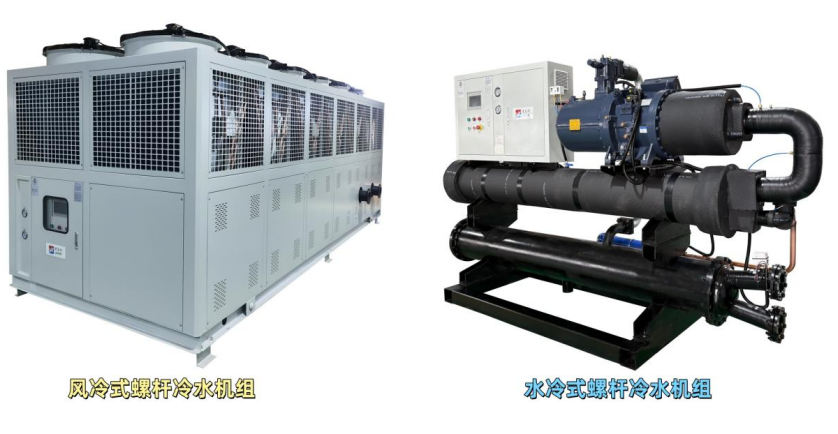
III. Core Logic for Scenario Selection
Air-cooled is preferred: cooling capacity ≤500 refrigeration tons, limited installation space, water shortage or need for flexible movement.
Water-cooled is preferred: cooling capacity >500 refrigeration tons, long-term full-load operation, pursuit of high energy efficiency (COP is 15%-20% higher than air-cooled), and stable water source.
Next Page

Address: No. 7-2, Heda Industrial Park, No. 18, Xinghua Road, Xiqing Economic and Technological Development Zone, Tianjin
135-1612-9919

Online Consultation
Please fill out this form, and we will contact you on the next business day.